
India's quick-commerce (qcom) industry is facing significant profitability challenges in metro markets due to saturation and intense competition, with the number of dark stores already exceeding profitable capacity, according to a Bernstein report.

Eternal-owned quick-commerce firm Blinkit has dropped its '10-minute' delivery claim after intervention by the Labour Ministry amid growing concerns over the welfare and safety of delivery workers.

A government Ayurveda doctor in Gurugram has been arrested for allegedly running over a delivery worker multiple times with his SUV following a dispute over parking.

'Why are the political leaders saying everything is normal?'

Ecommerce (ecom) and quick commerce (qcom) platforms are expected to lead gig worker hiring in calendar year 2026 (CY26), adding nearly 1 million workers on the back of sustained demand for last-mile deliveries, higher order volumes, and continued expansion of dark stores into non-metropolitan cities, industry experts have said.
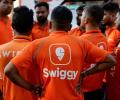
Food delivery aggregator Swiggy saw its loss widen for the fourth quarter (January-March) of financial year 2024-25 (Q4FY25). The firm reported a consolidated loss of Rs 1,081.1 crore for the quarter, compared to a loss of Rs 554.7 crore in the corresponding quarter of FY24.

Two of the three strikes are related to the gig economy, a centrepiece of the new labour Codes.

After a massive selloff in the shares of food delivery giants Zomato and Swiggy, analysts believe the time may be right for investors to start adding these stocks to their portfolio carts. Their optimism, they say, stems from the sharp correction in stock prices and valuations, which seem to have "over-baked" concerns about the two companies.

'Expect our food delivery business to deliver sustainable adjusted EBITDA margins of about 5 per cent in the medium term.'

For food aggregator platform Swiggy, quick commerce (qcom) is proving to be a better growth opportunity than food delivery. Its qcom arm Instamart is rapidly outpacing its core food delivery vertical across several key financial metrics, the company's recently filed draft red herring prospectus (DRHP) shows.

Framing the next chapter in Swiggy's journey as a responsible corporate citizen, co-founder and chief executive officer (CEO) Sriharsha Majety unveiled the company's eagerly awaited public listing. Majety, who has largely shunned the spotlight, shared reflections on his entrepreneurial path and the strategic pivots he and his co-founders navigated in building Swiggy. "We started with code aggregation, then pivoted to logistics, and that became Swiggy.

On the cusp of launching its Rs 11,327 crore initial public offering (IPO) next week, food and grocery delivery major Swiggy believes quick commerce to be its future growth engine and anticipates that it will outpace its core food delivery business over the next five years. Currently, the quick commerce business of Swiggy - backed by Prosus and SoftBank - is 40 per cent of the size of its food delivery revenues.

Zomato was not just recovering, it was rebuilding and reinventing, showing signs of maturing as a business. Chaos had been turned into momentum. A fascinating excerpt from Megha Vishwanath's book, UNSEEN: The Untold Story of Deepinder Goyal And The Making Of Zomato.

As the quick commerce (qcom) race hots up, a new model - vertical qcom - is gaining investor attention. Unlike horizontal players such as Blinkit, Zepto, and Swiggy Instamart, which stock everything from groceries to gifts and gadgets, vertical platforms focus on depth over breadth.
Food and grocery delivery major Swiggy on Thursday filed its updated draft papers with capital markets regulator Sebi to raise funds through its much anticipated initial public offering (IPO). The proposed IPO comprises a fresh issue of equity shares worth Rs 3,750 crore and an offer-for-sale (OFS) of 18.52 crore equity shares by existing shareholders, according to the updated draft red herring prospectus (UDRHP). Market sources have pegged the company's IPO size at over Rs 10,000 crore.
Food delivery app Swiggy on Wednesday launched a Rs 11,330-crore initial share sale, asking investors to take a pie of Indian middle class' rising propensity of online ordering. The company, which is present in over 650 cities and towns of the country, is launching the initial public offering (IPO) amid heightened concerns on urban demand slump, and the management stressed that it is unaffected by the broader trends in the economy. "We are also reading about it, but we are not seeing that yet in the business... So far, we have not seen the impact of demand on our business," its chief financial officer Rahul Bothra said.
Something is cooking in online food delivery. After 15 years of grappling with the demands of the business - read cash burn - Gurugram-based Zomato reported its first profit in the first quarter of 2023-24 (FY24). Not satiated, it reported a profit in the following quarter as well: Of Rs 36 crore in the second quarter compared to Rs 2 crore in the first. A year ago, in the second quarter of FY23, it had reported a loss of Rs 251 crore.

With razor-sharp focus on deliveries and customer experience, powered by strong in-house technology built ground-up, Swiggy is emerging as the food ordering platform of choice.

Festive sales are expected to surge 27 per cent to cross Rs 120,000 crore in 2025, driving Amazon and Flipkart to expand warehousing capacity by millions of cubic feet and extend delivery networks to thousands of new pin codes -- an infrastructure buildout that could reshape India's retail landscape for years.
Competition in the fast-growing quick commerce sector is heating up as Swiggy Instamart faces a tough challenge in narrowing the gap with Blinkit, which currently dominates the market. In the second quarter (Q2) of 2024-25 (FY25), Instamart's gross order value (GOV) rose by 42.1 per cent quarter-on-quarter (Q-o-Q) and 75.5 per cent year-on-year (Y-o-Y), reaching Rs 3,382 crore.

To make the service a hassle-free everyday option, Daily will allow users to schedule their meals in advance or opt for a daily, weekly or monthly subscription.

'We saw 581 chocolate orders per minute and 324 rose orders per minute.'

... catch up with Blinkit, Swiggy Instamart and Zepto...
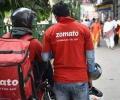
The filing of Swiggy's DRHP has led to direct comparisons with Zomato, which is a direct competitor in food delivery and the fast-growing quick-commerce segment where Blinkit (owned by Zomato) faces off against Instamart (and Zepto). In Q-commerce, Flipkart, Amazon, Reliance and Big Basket are all entering the space. All of them have deep pockets, hence competitive intensity will rise going forward.

Dark pods are physical stores or warehouses which will be accessible only to Swiggy staff and which will host groceries, pharmacies, and cloud kitchens.
Quick commerce (qcom) industry is poised to lead gig workforce hiring in 2025, propelled by a surge in demand for faster deliveries, expansion by existing players, entry of new competitors, and evolving consumer preferences in the post-pandemic era, according to industry experts. The qcom industry currently employs nearly 260,000 people - around 200,000 delivery personnel and 60,000 dark store workers, according to TeamLease Staffing.

Over the years, with some amount of experimenting, I have learnt exactly what freezes well and what does not.
The latest round of funding values the company at $10.7 billion, almost doubling it from the $5.5 billion valuation during the $1.25 billion fund raise in July 2021 when investors including SoftBank, Prosus and Accel pumped in capital in what was the company's biggest funding since its inception. The other new investors in the latest round of funding include Baron Capital Group, Sumeru Venture, IIFL AMC Late Stage Tech Fund, Kotak, Axis Growth Avenues AIF- I, Sixteenth Street Capital, Ghisallo, Smile Group and Segantii Capital, Swiggy said in a statement.

The first step in Swiggy's local commerce idea is to tie up with supermarket chains, pharmacies, meat shops, pet stores, flower vendors and others. This is Swiggy's evolution from being a food-delivery company to a "deliver anything" unicorn.

Given that people have been reluctant to order cooked food - which worsened due to a couple of cases of delivery personnel testing positive for COVID-19 - food delivery platforms have included grocery delivery as part of their services.
Food delivery apps Zomato and Swiggy reported a nationwide outage on Wednesday. Both the platforms witnessed technical glitches and were unresponsive for almost an hour. Downdetector, a platform that collects status reports from a series of sources, recorded about 3,619 reports of outage against Zomato at 2:05 PM and about 771 reports of outage against Swiggy at around 2:21 PM. According to the sources, the outage was caused by Amazon Web Services (AWS), a cloud-services platform, which runs both platforms. Though Swiggy and Zomato are working now, some customers reported that the issue has not been solved completely and they are not able to place orders and there are payment related issues.

The Confederation of All India Traders (CAIT) representing 70 million traders has written to Union Commerce Minister Piyush Goyal, drawing his attention to the alleged violations of laws and regulations by quick commerce (qcom) companies.
The funding marks the first investment in the Indian food delivery category by SoftBank Vision Fund 2, with participation from the company's long-term investor, Prosus, and other existing investors Accel Partners and Wellington Management, Swiggy said in a statement. In addition, new investors Qatar Investment Authority, Falcon Edge Capital, Amansa Capital, Goldman Sachs, Think Investments and Carmignac participated in the round, it stated. This latest fundraise was heavily oversubscribed following strong interest from investors, and comes on the back of Swiggy's rapid recovery from the impacts of COVID-19 and subsequent growth in 2020-21, Swiggy said.

'We cannot enter any flat in Satguru building until the watchman gives us access.'

After making the model work in metro cities, players in the quick commerce sector are rapidly expanding their footprint into smaller tier 2 cities and markets beyond that ahead of the festival season.
Swiggy is following a path that seems similar to what Meituan, one of China's largest O2O (online-to-offline) platforms that delivers food, sells movie tickets and offers hotel reservation, has done so far, reports Patanjali Pahwa.

Food delivery firm Zomato Ltd said on Wednesday most stores of its grocery unit Blinkit had resumed operations after being shut following protests by delivery partners. "Over the last few days we have made changes in the delivery partner payout structure with respect to the Blinkit business to address the needs of delivery partners, improve customer experience and reduce cancellation/ order rejection frauds by few delivery partners in the system. "Such changes are done from time to time, as needed," said the company in a letter to the BSE.

Union Minister of Commerce and Industry Piyush Goyal's recent comments on large e-commerce players have reignited the debate about their impact on smaller offline retailers. On Wednesday, Goyal said that the rapid growth of e-commerce in India is a "cause for concern" and is diminishing the market share of small, mom-and-pop stores by offering high-margin products such as consumer electronics and apparel at discounted rates.
Companies like Flipkart, Amazon and Meesho as well as quick commerce ones like Blinkit, Zepto and Swiggy Instamart may create hundreds of thousands of seasonal jobs for the coming festival season.

As quick commerce gains ground, emerging direct-to-consumer (D2C) brands are betting big on digital channels to drive growth. According to Aman Gupta, co-founder of wearables brand BoAt, new-age brands in India have been expanding at a much faster pace than expected, driven by digital channels like quick-commerce. "Investors doubted the potential of D2C brands when we started, but today there are multiple brands in the startup market that are growing on the shoulders of these digital channels," Gupta said while addressing a session at Razorpay's D2C and Retail Summit recently.
 © 2026 Rediff.com - Advertise with us - Disclaimer - Privacy Policy - Sitemap - Feedback - About us - Terms of use - Grievances